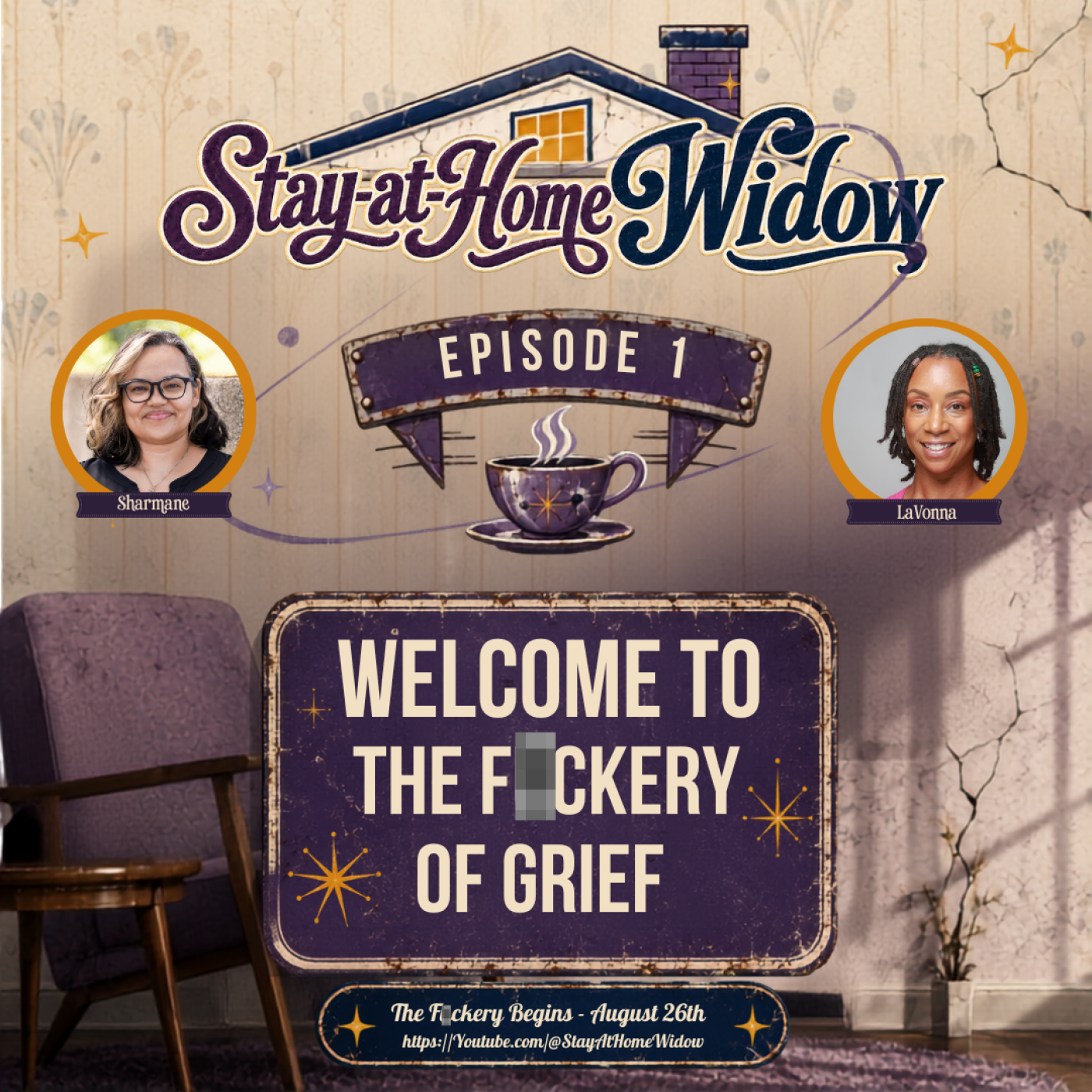
Welcome to the Fuckery: Why We Needed Stay-at-Home Widow
There are plenty of words people use when someone you love dies.
Healing. Closure. Acceptance. Moving on. Letting go.
We hate most of them.
Not because everyone who uses those words means harm, but because very few of them seem big enough, messy enough, angry enough, or honest enough to describe what it actually feels like when your person is suddenly gone and the life you understood disappears with them.
So, apparently, we needed some new words.
Welcome to Stay-at-Home Widow.
We are Sharmane Fury and LaVonna, two friends who have known each other since childhood. Our lives and families have been intertwined for decades. We have been friends, family, cousins-not-cousins, sisters-not-sisters.
Then, 11 months apart, we both became widows.
This is not a club either of us wanted to join.
But since we're here, we decided we need to talk about the fuckery.
We Are Not Here to Teach You How to Grieve
Let's get this out of the way first.
We are not therapists. We are not grief experts. We are not life coaches. We do not have a five-step program for rebuilding your life after your partner dies.
We are two widows speaking from our own experiences.
That distinction matters because grief is deeply personal. Something that helps one of us might do absolutely nothing for someone else. Something we can laugh about today might knock us flat next month.
We are trying to figure out how to exist in a life reshaped by loss, and talking about it is part of how we do that.
In fact, that is part of the point.
There are things about widowhood neither of us understood until we were living them. Things nobody warned us about. Things that suddenly our bodies, brains, and relationships were forced to understand firsthand.
Gut-wrenching.
Sick with grief.
Waking up crying.
Being so physically overwhelmed by sadness that you wonder how your body is possibly doing all of this while you're just sitting there watching television.
Nobody gave us a manual for that shit.
We Need Better Language for Grief
One of the things we kept coming back to in our first episode was language.
What exactly are we doing now?
Are we rebuilding?
Recreating?
Maneuvering?
Moving forward?
We know what we're not doing.
Moving on.
Moving on implies that the person, the relationship, and the life you shared belong somewhere behind you.
No.
Time moves forward whether we want it to or not. We can move forward because we don't really get a choice about that.
But moving on?
From someone who occupied decades of your life?
Why would we want to?
The same goes for “letting go.” There may be things we eventually have to let go of, expectations, routines, plans for a future that can no longer happen the way we imagined. But the people we loved are part of who we became.
We're not interested in pretending otherwise.
Part of this show is about finding language that feels more honest. Maybe we'll discover some of it. Maybe we'll make some of it up along the way.
Maybe you'll give us some of it.
The Ugly Parts of Grief
We also want to talk about the feelings that don't look particularly good.
The anger.
The resentment.
The jealousy.
The days when someone you genuinely love posts about their wedding anniversary and one part of you is thinking, I am so happy for you, while another part is thinking, I really do not want to see this shit today.
That second thought can make you feel like an asshole.
It can make you wonder what grief is turning you into.
One of the most freeing things about talking to another widow is being able to say the ugly thought out loud and hear someone say, “Yep.”
You can love your friends and still be hurt by seeing the life they still have.
You can celebrate somebody and wish you didn't have to witness their celebration that day.
You can know intellectually that their happiness has absolutely nothing to do with your loss and still have your whole body react before your better judgment catches up.
That doesn't mean you want their marriage to disappear.
It means yours did.
Those are different things.
We want room here for that difference.
We Are Tired of Performing Strength
There is also a particular kind of pressure that comes with being women who have spent most of our lives being seen as strong.
Keep going.
Handle your business.
Go to work sad.
Take care of everybody sad.
Get your degrees sad.
Show up sad.
Be resilient.
We're especially interested in what that looks like for Black and Brown women because so much of what we are taught about survival is built around continuing to function no matter what is happening inside of us.
And sometimes you cannot.
Sometimes you're having a "widow day."
That's the phrase Sharmane started using when grief makes whatever was supposed to happen that day simply not happen.
A widow day doesn't necessarily mean lying on the floor dramatically sobbing.
Sometimes it's just:
Nope.
Not today.
I'm staying in bed.
The world will have to continue without me for a minute.
Maybe tomorrow will be different.
Grief Changes Your Relationships Too
Loss doesn't only change your relationship with the person who died.
It changes your relationship with almost everybody who is still here.
Some people disappear because they don't know what to say.
Some people love you deeply but become visibly uncomfortable because they're afraid you might “grieve on them.”
Sometimes another grieving person desperately wants to support you and discovers that your experience is triggering their own grief so intensely that they temporarily can't.
Even between the two of us, sharing the same kind of loss didn't automatically make this easy.
Sharmane's husband, Tristan, died first. When LaVonna's husband died 11 months later, Sharmane thought she would immediately know how to show up for her.
Instead, some conversations brought Sharmane straight back into the earliest days of her own loss.
There were times she couldn't be there the way she wanted to be.
And LaVonna understood.
That matters too.
Sometimes loving somebody means knowing your current capacity and being honest about it instead of disappearing without explanation.
We are both learning how to do that.
Leaving a Ladder
At one point during our first conversation, LaVonna described what she hopes comes from doing this show.
She said she wants to leave a ladder.
That may be the best description of what we're trying to do here.
We are trying to find our own way out of the fire while leaving something behind that another person might be able to grab when the heat reaches them.
Not instructions.
Not a roadmap.
Not “10 Ways to Thrive After Losing Your Husband.”
A ladder, a path that still connects to our past.
That is what we hope Stay-at-Home Widow can become.
Not a place where grief gets cleaned up magically.
A place where we can actually talk about it.
The sadness.
The rage.
The memories.
The loneliness.
The friendship.
The dark jokes.
The unexpected jealousy.
The love that is still here even though the person isn't.
The rebuilding.
And, of course, all the fuckery.
We don't have a formula yet.
We're just two friends, both grieving our husbands, trying to figure out what comes next.
Come figure it out with us.
Welcome to Stay-at-Home Widow.